Oracle Exadata X11M Next Generation Hardware Available Everywhere

Oracle today announced Oracle Exadata X11M, labelled as the Next Generation Intelligent Data Architecture which enable Exadata Exascale Intelligent Data Architure for the Cloud Era.

Hardware Changes

In the database server, the CPU moves from AMD EPYC 9J14 to 9J25, whilst still retaining 96 cores, they are up to 25% faster. Same memory sizes but up to 33% faster DRAM.

In the storage server, the flash is now up to 2.2x faster then 10M, with CPU up to 11% faster and DRAM 33% faster.

The amount of flash, memory, and disk remains unchanged from X10M.

Both storage server high capacity and and extreme flash remain unchanged, however the database server eighth rack and storage server eighth rack is now called database server-Z and storage server high capacity-Z.

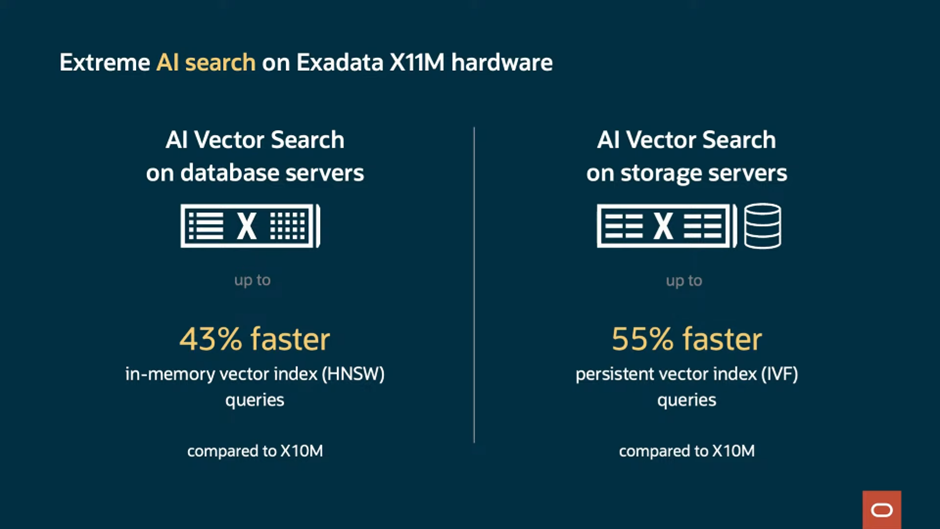
AI search are now further accelerated on X11M with AI vector search on database severs up to 43% faster with in-memory vector index (HNSW) queries and AI vector search on storage servers up to 55% faster with persistent vector index (IVF) queries.
The I/O latency was already impressive on the X10M at 17us, but Oracle have managed to reduced this now to 14us to give 21% faster XRMEM read latency and up to 43% faster flash OLTP read latency.

Software Changes

Exadata X11M has a new intelligent power efficiency capability that can limit the power consumption of the database server CPUs dynamically to save power when workload demand is low. It can also intelligently turn off unneeded cores to further conserve energy. Couple with hardware changes, this allows for running more databases and workloads or run same workload using less hardware due to the extreme performance enabling efficiently consolidate.

Available Everywhere

Oracle now has Exadata in all leading cloud providers, making Exadata accessible to even more customers.

Couple this with Exascale, which is currently limited to OCI but will in future be on Exadata Cloud@Customer, OCI Dedicated Region, and multi-cloud environments, will make Exadata even more accessible with low entry cost point and pay per use.

For more Info

Please refer to the following links:

If you found this blog post useful, please like as well as follow me through my various Social Media avenues available on the sidebar and/or subscribe to this oracle blog via WordPress/e-mail.

Thanks

Zed DBA (Zahid Anwar)

Oracle Database 23c now Oracle Database 23ai

Announcement

In case you missed it, yesterday 2nd May 2024 at 5pm (GMT) Larry Ellison and Juan Loaiza announced Oracle Database 23ai under the banner of “AI + Converged Data: Oracle’s Strategy for Data Management”. You can see the announcement here:
AI and Converged Data: Oracle’s Strategy for Data Management – YouTube

I was conveniently at the UKOUG Technology Strategy Day (LinkedIn post here), where Scott Hays, Steve Ramsay, Dominic Giles and Killian Lynch plus others were. They all alluded to big announcement that evening but for obvious reasons couldn’t share the details. But in the leading hours, I had seen posts on social media with the “23ai” name, which lead me to believe the rename was going to be part of the announcement 🙂 Post 5pm, was able to speak freely with Dom and Kilian and it totally makes sense, we’re in the era of AI, it’s the latest buzz word, we were due a letter change for some while now! Oracle’s slogan is “Bring #AI algorithms to where your data lives with Oracle Database 23ai”.

Versions over the eras

8i and 9i were for the era of internet, 10g and 11g for the era of grid, and finally 12c, 18c, 19c, 21c and 23c (up to 23.3) for era of cloud. 23ai is actually from 23.4 onwards and the release that will be the mainstream General Available (GA) release.

What’s New

There so much that new, which Oracle have broken down into 3 areas, see below:

AI for Data

  • Oracle AI Vector Search
  • Oracle Exadata System Software 24ai
  • OCI GoldenGate 23ai

Accelerating App Development

  • JSON Relational Unification
  • Graph Relational Unification
  • Free Developer Databases

Mission-Critical Data

  • Oracle Globally Distributed Database with RAFT
  • Oracle True Cache
  • In-Database SQL Firewall

More details of each feature is available here.

Support

Oracle Database 19c as of writing has Extended Support (waived) is till 30th April 2026, so customers have 2 years to move from 19c to 23ai. Latest dates can be found here:
Release Schedule of Current Database Releases (Doc ID 742060.1)

Availability

Oracle Database 23ai is only available on Oracle Exadata Cloud@CustomerOCI Exadata Database Service, OCI Base Database Service and Azure Oracle Database Service. It also available on Always Free Autonomous Database as well for download in the Autonomous Database 23ai Container Image and Oracle Database 23ai Free. For the rest we have to wait for GA which I suspect is very imminent, weeks not months.

Where to get more info

If you found this blog post useful, please like as well as follow me through my various Social Media avenues available on the sidebar and/or subscribe to this oracle blog via WordPress/e-mail.

Thanks

Zed DBA (Zahid Anwar)

Oracle switches to AMD for full Exadata X10M lineup, what else is new?

Chipset switch to AMD

So back in September 2022, I noticed the Oracle Exadata Cloud Infrastructure X9M switched to AMD, where as the Exadata X9M On-premises and Exdata X9M Cloud @ Customer remained on Intel. More details in my blog post here.

It come as no surprise the whole lineup has now switched to AMD! Why? Well putting it simply AMD has beaten Intel on the number of cores for sometime now and with the scalability of Exadata it make senses to have the upper limit cores that AMD offers. Oracle is now using the AMD EPYC 9J14 processors.

Where has the Persistent Memory gone?

Since Exadata X8M, Intel Optane Persistent Memory has existed in the storage cells, bringing an additional layer to the multi-tiered storage architecture. Persistent Memory has the benefit of being order of magnitude faster then Flash but at the fraction of the cost of DDR memory resulting in the Exadata Persistent Memory Data Accelerator.

Simply put, you can’t have AMD chipset with Intel Optane Persistent Memory, so Oracle had to come up with a new solution which they glossed over in the announcement. Which they replaced the Persistent Memory with DDR5 memory and address the memory from the compute nodes using the new feature called Exadata RDMA Memory (XRMEM). This extends the existing Remote Direct Memory Access (RDMA), to create a new shared read accelerator. Interesting Oracle compromised on the writes accelerator that Persistent Memory gave but they would have done the analysis and probably Persistent Memory was largely fronting reads and the penalty to flush to Flash instead of Persistent Memory probably wasn’t that significant. There is now 1.5TB DDR5 DRAM in storage cell compared to 256GB in X9M with 1.5TB Persistent Memory.

What else is new?

The other highlights are:

  • Increased memory configuration of 512GB, 1.5TB, 2.25TB and 3TB DDR5 DRAM in the compute nodes
  • PCIe 4 replaced with PCIe 5, to give 2x 100Gb/sec active-active RoCE network for impressive total throughput of 200Gb/sec
  • Extreme Flash storage server now has the introduction of “capacity optimised” flash drive combined with “performance optimised” flash cards to give impressive increase of 2.4x over X9M
  • 22TB disks instead of 18TB on X9M, giving 22% increase storage

Those that know me, will know I have been predicting:

  • Full switch to AMD chipset for whole Exadata lineup
  • Some sort of replacement for Persistent Memory
  • 22TB hard disk drives

I’m glad to say I was right on all accounts 🙂

For more Info

Please refer to the following links:

If you found this blog post useful, please like as well as follow me through my various Social Media avenues available on the sidebar and/or subscribe to this oracle blog via WordPress/e-mail.

Thanks

Zed DBA (Zahid Anwar)

Oracle Switches CPU from Intel to AMD for Exadata Cloud Services

Working on Oracle Exadata Cloud Infrastructure X9M, I noticed the upper OCPU went up pretty high compared to X8M. This made me curious and I discovered the switch from Intel to AMD for the CPU:

Exadata X9M (Exadata Cloud Services)

[root@v1exacs01c1db01 ~]# more /proc/cpuinfo | grep "vendor_id|model name" | sort | uniq -c
8 model name : AMD EPYC 7J13 64-Core Processor
8 vendor_id : AuthenticAMD
[root@v1exacs01c1db01 ~]#

Compare this to on-premises Exadata and they are still Intel processors:

Exadata X9M (on-premises)

[root@v1exadb01 ~]# more /proc/cpuinfo | grep "vendor_id|model name" | sort | uniq -c
76 model name      : Intel(R) Xeon(R) Platinum 8358 CPU @ 2.60GHz
76 vendor_id       : GenuineIntel
[root@v1exadb01 ~]#

Comparing with previous Exadata Cloud @ Customer and this is also still Intel processors:

Exadata X8M (Exadata Cloud @ Customer)

[root@v1exacc01c1db01 ~]# more /proc/cpuinfo | grep "vendor_id|model name" | sort | uniq -c
6 model name      : Intel(R) Xeon(R) Platinum 8270CL CPU @ 2.70GHz
6 vendor_id       : GenuineIntel
[root@v1exacc01c1db01 ~]#

This change make sense as the latest Intel processor is the “Intel® Xeon® Platinum 8358 Processor”, which has 32 cores and 64 threads.

Compare this with latest AMD processor “AMD EPYCâ„¢ 7713”, which has 64 cores and 128 threads. I believe the AMD EPYC 7J13 in the Exadata Cloud Infrastructure X9M is of the same family.

This allows Oracle to offer 252 OCPU for Quarter Rack, 2 sockets x 64 cores x 2 database servers less 2 cores per database servers for KVM. This is double what could be offered if Intel processors were used. And seems as Oracle charge per a OCPU, it’s a smart move that was quietly done 😉

If you found this blog post useful, please like as well as follow me through my various Social Media avenues available on the sidebar and/or subscribe to this oracle blog via WordPress/e-mail.

Thanks

Zed DBA (Zahid Anwar)

Oracle and Microsoft to Interconnect Oracle Cloud and Microsoft Azure

On the 5th of June 2019, both Oracle and Microsoft made a joint announcement on the interconnection between Oracle Cloud and Microsoft Azure:

Oracle’s Press Release
Microsoft Press Release

The key aspects of the announcement are:

  1. A direct interconnect between Oracle Cloud and Azure Cloud, starting in Oracle’s Ashburn (North America) region and Azure Washington DC (US East) region, with plans to expand additional regions in the future*.
  2. Unified identity and access management, via a unified single sign-on experience to manage resources across both Oracle Cloud and Azure.
  3. Supported deployment of custom applications and packaged Oracle applications (such as JD Edwards, PeopleSoft and E-Business Suite typically referred to as Oracle Applications Unlimited) in Azure Cloud with the Oracle databases (such as RAC, Exadata, Autonomous Database) deployed in the Oracle Cloud.
  4. A collaborative support model for customers leveraging these new capabilities.

*With only one region available in both Oracle and Azure, this will allow for failure in a Availability Domain in Oracle Cloud and/or Availability Zone in Azure Cloud but not a failure of a whole region in either.  So until more regions are added, Disaster Recover will be limited to Availability Domains/Availability Zones:

oracle-azure-connectivity

Figure 4 from Oracle’s blog “Overview of the Interconnect Between Oracle and Microsoft“.

What does this mean?

In a nutshell, for those customers who have Microsoft Azure as their Cloud platform of choice, can now migrate their application tier to Microsoft Azure, whilst migrating the database tier i.e. Oracle database (mandatory for Application Unlimited) without having to worry about the all important latency (high-throughput, low-latency as stated in Oracle’s blog post).  It is however unclear if there will be any charge for outbound/inbound traffic between the clouds, but it does seem from the documentation and blog post that both Oracle’s dedicated FastConnect and Azure’s dedicated ExpressRoute are required, which are both fix rate products.  It also helps those customers who require the favourable database licensing on the Oracle Cloud, more info can be found in my blog post here.

This is certainly a step towards the trend of multi-cloud/hybird-cloud platforms.

More info can be found regarding this announcement from our Version 1’s blog post here.

Another interesting read from SearchCloud Computing in regards to this announcement.


If you found this blog post useful, please like as well as follow me through my various Social Media avenues available on the sidebar and/or subscribe to this oracle blog via WordPress/e-mail.

Thanks

Zed DBA (Zahid Anwar)